
The True Cost of Rest Homes: Why a Granny Flat Wins on Every Level
- Nelson Baguio
- Apr 17
- 20 min read

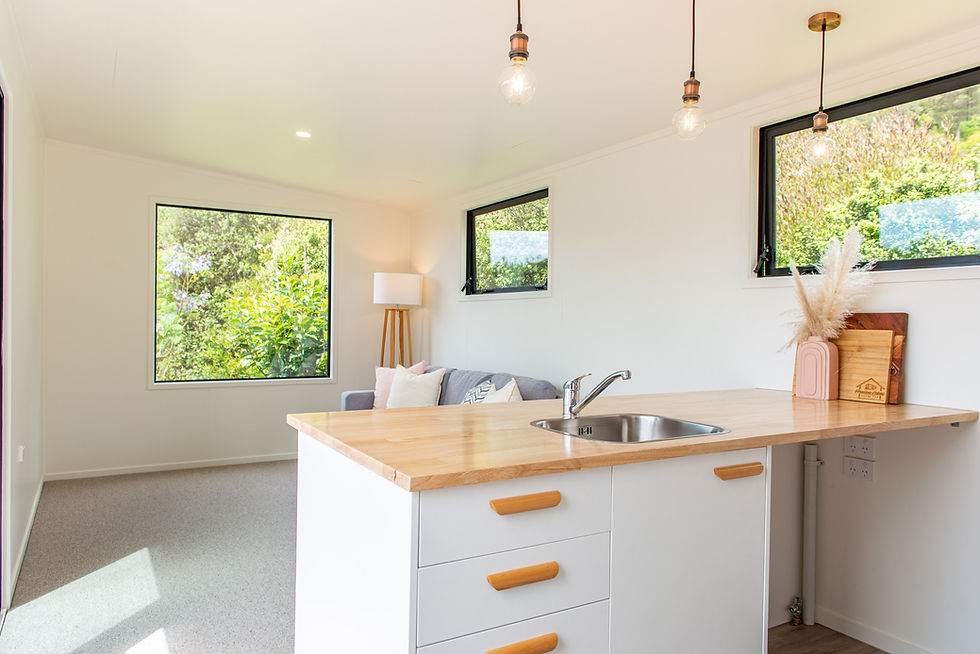
Rest homes cost $80K-$100K/year and destroy family bonds. A granny flat costs $120K once and keeps families together.
Here's the math and psychology nobody talks about.
Let me tell you about two different versions of aging in New Zealand.
Version 1: Margaret
Margaret is 76. Three years ago, her kids moved her into a rest home in Auckland. It costs $95,000 a year. She shares a room with a stranger. She eats meals she didn't choose at times she didn't pick. Her daughter visits Sundays for an hour. Her grandchildren come maybe once a month – it's "too sad" for them. Margaret is safe. She is cared for. She is also slowly disappearing.
Version 2: Joan
Joan is 78. Two years ago, her daughter put a granny flat on the property in Tauranga. It cost $126,000 once. Joan has her own kitchen, her own bathroom, her own front door. She makes Sunday roast for the family. She helps with homework when the grandkids need it. She's at every birthday, every school play, every random Tuesday night dinner. Joan is thriving. Same age. Same general health. Completely different outcomes.
Let me show you why the granny flat wins on every single level – financial, psychological, social, and with family.
This isn't about rest homes being "bad." It's about families having another option. A better option. An option the rest home industry really doesn't want you to know about.
THE FINANCIAL DEVASTATION OF REST HOMES

Let's start with money, because it's the easiest to quantify.
What Rest Homes Actually Cost in NZ (2026)
Here are the real numbers across New Zealand:
Major Cities: | |
Auckland | $90,000 - $120,000/year |
Wellington | $85,000 - $110,000/year |
Christchurch | $75,000 - $95,000/year |
Tauranga/BOP | $80,000 - $100,000/year |
Hamilton | $75,000 - $95,000/year |
Dunedin | $70,000 - $90,000/year |
National average | $80,000 - $100,000 per year |
That's not for dementia care. That's not for high-needs medical supervision. That's standard rest home care for someone who just can't manage living alone anymore.
Let's do the math on what this actually means over time:
5-year timeline:
Year 1: $90,000
Year 2: $90,000
Year 3: $90,000
Year 4: $90,000
Year 5: $90,000
Total: $450,000
10-year timeline:
Total: $900,000
15-year timeline (not uncommon):
Total: $1,350,000
That's one point three million dollars. Gone. With nothing to show for it at the end.
What a Granny Flat Actually Costs
Now let's compare to a Freedom Cabin

The Classic 60m² (our most popular):
Cabin: $119,900
Site prep (foundations): $6,000
Services (power/water/waste): $4,500
Landscaping/deck (optional): $6,000
Total project cost: $136,400
One-time expense. Done.
The Break-Even Analysis
When does the granny flat pay for itself compared to rest home fees?
Rest home at $90,000/year:
Month 1-18: You're spending money on the cabin
Month 19: Break-even point
Month 19+: Pure savings
The granny flat pays for itself in 18 months. After that, every single month you're saving $7,500.
Year 3: You're $180,000 ahead
Year 5: You're $314,000 ahead
Year 10: You're $764,000 ahead
And here's the kicker
After 10 years, you still own a $120,000+ asset that you can:
Rent out for $18,000-$23,000/year
Use for another family member
Airbnb for $25,000-$40,000/year
Sell with the house (adds property value)
Relocate to another property
The rest home? You've burned through $900,000 with nothing to show for it except receipts and regret.
The Compounding Effect (Nobody Talks About This)
But wait, it gets better.
Most families pay for rest homes from:
The parent's savings
Selling the parent's house
Family contributions
Eventually, the inheritance
Scenario: Mum owns a $650,000 house in Auckland
Rest home path:
Sell Mum's house: $650,000
Pay rest home fees: $90,000/year
Year 7: Money runs out
Year 7+: Family starts paying, or Mum goes on subsidy
Family inheritance: $0
Granny flat path:
Keep Mum's house (or sell it for other reasons)
Build granny flat: $136,400
Mum lives on your property: 10+ years
Rent out Mum's house: $35,000/year
Rental income: $350,000 over 10 years
When Mum passes: House still worth $650,000+ (probably more)
Family inheritance: $650,000+ house, plus $350K rental income, minus $136K cabin
Net outcome: $864,000+
Difference: $864,000 vs $0
That's generational wealth being preserved vs destroyed.
The Hidden Costs of Rest Homes (Beyond the Invoice)
Rest home fees are just the start. Here are costs that never appear on a bill:
Ongoing family costs:
Petrol for weekly visits: $2,000/year
Replacing lost/damaged clothing: $500/year
Supplemental food (they hate the meals): $1,000/year
Extra entertainment/outings: $1,500/year
Gifts to "make up for" putting them there: $1,000/year
Therapy for your guilt: $3,000/year (yes, this is real)
Total hidden costs: $9,000/year
Over 10 years: $90,000
With a granny flat? These costs disappear. Mum's doing her own shopping, cooking her own meals, and seeing you every day anyway.
What If You Don't Have $136,000 in Cash?

Fair question. Most people don't have that sitting in a savings account.
Here's how families actually fund granny flats:
Option 1: Home equity
If you own your house and have equity, extend your mortgage.
Borrow $140,000 at 6.5% over 20 years
Repayment: ~$1,050/month
Rest home alternative: $7,500/month
Net monthly savings: $6,450
You're massively cash-flow positive from month one.
Option 2: Parent's savings
If Mum has $150,000 in savings earmarked for her care, use it upfront.
Buy granny flat: $136,000
Remaining: $14,000 for her ongoing expenses
She lives on your property: 10+ years
Savings not depleted by rest home fees
Option 3: Sell parent's house
If Mum owns a house she can't manage:
Sell house: $500,000
Buy granny flat: $136,000
Invest remaining: $364,000
Investment income (5% return): $18,200/year
She has her own space AND income from investments
Option 4: Family contribution
Split cost between siblings:
Total cost: $136,000
Three siblings: $45,000 each
Alternative: Mum's inheritance gets eaten by rest home fees
Your $45K preserves everyone's inheritance
Option 5: Build now, rent later
Build the cabin, Mum lives in it. When she doesn't need it:
Rent for $380/week: $19,760/year
Over 10 years: $197,600 income
Cabin pays itself off through rental income
The point: There are multiple paths to make this financially work. And every path is better than $90,000/year disappearing into rest home fees.
The Tax Angle (Bonus)
I'm not an accountant, but here's something to discuss with yours:
Rest home fees: Not tax-deductible (it's personal care)
Granny flat if rented:
Depreciation claims (potentially)
Interest deductibility (if mortgaged, rules apply)
Expense deductions (maintenance, insurance)
Granny flat if Mum pays you rent:
Structured properly, might have tax advantages
Consult your accountant
The point is: The granny flat has potential tax benefits. Rest homes have none.
Real Example: The Anderson Family (Auckland)
Let me show you a real case study:
The Andersons - Remuera, Auckland
Situation in 2023:
Mum (Patricia, 74) in rest home: $98,000/year
Patricia's house sold to pay fees: $780,000
Money in bank earning 3%: $23,400/year
Net cost: $98,000 - $23,400 = $74,600/year
Years until money runs out: 10.4 years
What they did in January 2024:
Bought Freedom Cabin Classic 60m²: $119,900
Site prep and setup: $11,500
Total: $131,400
Remaining from house sale: $648,600
Invested at 5%: $32,430/year income

Outcome after 2 years:
Patricia living on daughter's property
Sees grandkids daily
Health improved (more active, better mood)
Investment income: $32,430/year (more than covers her expenses)
Family no longer stressed about money running out
Preserved wealth: $648,600 still in bank, plus $131,400 asset
Projected outcome at 10 years:
Investment account: $648,600 grown to ~$850,000
Granny flat: Still worth $130,000+
Total family wealth: $980,000
Comparison to rest home path:
Rest home fees over 10 years: $980,000
Money left: $0
Total family wealth: $0
Difference: $980,000
That's the real cost of rest homes. It's not just the annual fee. It's the complete obliteration of family wealth.
PART 2: THE PSYCHOLOGICAL DEVASTATION OF REST HOMES

Now let's talk about the part that doesn't show up on spreadsheets.
What Rest Homes Do to Mental Health
There's solid research on this, and it's grim
Depression rates in rest homes:
40-60% of rest home residents show signs of depression
Compare to 15-20% in community-dwelling elderly
That's 3x higher
Why?
Loss of independence
Loss of purpose
Loss of control over daily life
Loss of social connection
Loss of identity
You know what's insane?
We take a functioning 75-year-old who just needs a bit of help with heavy housework, and we put them in an environment that:
Tells them when to eat
Tells them what to eat
Tells them when to sleep
Gives them nothing meaningful to do
Surrounds them with people who are often severely cognitively impaired
And then we wonder why they deteriorate rapidly.
The Learned Helplessness Effect
Psychologists have a term for this: learned helplessness.
When you remove someone's agency – their ability to make choices and affect their environment – they stop trying.
In a rest home:
Someone else makes your meals → You stop cooking → You forget how
Someone else cleans your space → You stop tidying → You lose that capability
Someone else plans your day → You stop initiating → You become passive
Someone else makes decisions → You stop thinking ahead → Cognitive decline accelerates
It's not malicious. But it's devastating.
In a granny flat:
You make your own breakfast → You maintain that skill
You tidy your own space → You maintain that capability
You decide what to do today → You maintain agency
You manage your own life → You maintain cognitive function
The difference in outcomes is stark.
The Purpose Gap
Humans need purpose. Especially after retirement.
In a rest home: Your purpose is... what, exactly? Eat three meals, do some crafts, wait for visiting hours?
In a granny flat: You can still contribute:
Make Sunday roast for the family
Help grandkids with homework
Tend a small garden
Babysit occasionally (if able and willing)
Share wisdom and life experience
Be part of family decision-making
One of our customers (Margaret in Bethlehem) told us:
"Mum was in a rest home for 6 months. She aged 5 years. Since moving into the cabin, she's got her spark back. She makes breakfast for the grandkids before school. She helps with their reading. She bakes. She's Nana again, not just 'the old lady in the home.'"
That's purpose. That's dignity. That's life worth living.
The Social Isolation Paradox
Here's what nobody tells you about rest homes:
Yes, you're surrounded by people. But you're completely socially isolated.
Why?
Your roommates (if shared room) aren't your friends
Other residents are often cognitively impaired (can't hold conversation)
Staff are overworked and rushing
Family visits are scheduled and time-limited
Your real social network (friends, neighbors) can't visit easily
You're alone in a crowd. Which is worse than being alone alone.
In a granny flat:
Your actual family is 10 metres away
Grandkids pop over spontaneously
Friends can visit in your own space (not a shared institutional room)
You can host people (make tea, have a chat)
You're part of daily family life
Quality of social connection matters infinitely more than quantity of bodies in a building.
The Identity Erosion
Who are you in a rest home?
You're "Bed 12." You're "the woman in Room 6." You're "Mrs. Smith who needs help showering." Your identity shrinks to your care needs.
In a granny flat:
You're still Nana. You're still Mum. You're still the woman who makes the best roast lamb in the family. You're still the one who knows all the family stories.
Your identity remains intact.
The Autonomy Factor
Let's do a comparison of a typical day:

Rest home resident:
Wake up: When staff start rounds (usually 6:30-7am)
Breakfast: 8am in dining room (no choice on timing)
Morning: Sit in common area or room
Activities: If offered, usually crafts or TV
Lunch: 12pm (no choice on timing)
Afternoon: More sitting, maybe a walk if staff available
Dinner: 5:30pm (no choice on timing)
Evening: TV in common area
Bed: Usually by 8pm (staff encourage this for their convenience)
Granny flat resident:
Wake up: Whenever you want
Breakfast: What you want, when you want
Morning: Pop over to see grandkids before school, or sleep in, or read, or garden
Lunch: Make yourself something, or join family
Afternoon: Your choice – rest, hobbies, visit friends, help with kids
Dinner: Often with family, sometimes alone, your choice
Evening: TV, reading, family time, whatever you want
Bed: When you're tired
One is institutional living. The other is actually living.
The Cognitive Decline Acceleration
Research shows that rest home residents experience faster cognitive decline than community-dwelling elderly, even when controlling for baseline health.
Why?
Less cognitive stimulation (routine is numbing)
Fewer decisions to make (use it or lose it)
Less physical activity (no reason to move around)
Less social engagement (superficial interactions)
Depression (which accelerates dementia)
With a granny flat:
Daily cognitive stimulation (conversations, helping kids, managing own space)
Constant small decisions (what to eat, what to wear, what to do)
More physical activity (cooking, light housework, walking to main house)
Meaningful social engagement (actual relationships)
Lower depression rates (purpose and family connection)
We've had multiple families tell us their parents' health actually improved after moving from a rest home to a granny flat.
Not because of medical care. Because of life quality.
PART 3: THE FAMILY PSYCHOLOGICAL IMPACT

This isn't just about the parent. It's about everyone.
The Guilt Burden
Every single family we've worked with who had a parent in a rest home mentions guilt.
"I feel guilty every time I leave.""I feel guilty I don't visit more.""I feel guilty we put her there.""I feel guilty enjoying my day when she's stuck there."
This guilt is corrosive. It eats at you. It affects your mental health, your marriage, your relationship with your kids.
With a granny flat:
The guilt evaporates. Mum's not "there" – she's here. You check on her every morning. She comes to dinner. She sees the kids daily.
You're not visiting an institution. You're living near family.
One customer told us: "The relief was immediate. First day Mum moved into the
cabin, I slept better than I had in two years. She was home."
The Marriage Strain
Rest home decisions strain marriages.
Common conflicts:
How much to visit (one spouse wants daily, other thinks weekly)
How to split costs (especially with siblings)
Guilt management (one feels more guilty than the other)
Disagreement on quality of care
Resentment about time spent visiting vs family time
With a granny flat:
These conflicts disappear:
No decision about visit frequency (she's right there)
Clear one-time cost (not ongoing burden)
Less guilt means less tension
You can monitor care yourself (you're providing it)
Family time and Mum time aren't separate things
The Impact on Children (Your Kids)

This is huge and nobody talks about it.
Kids with grandparents in rest homes:
See death and decline as scary, medical, institutional
Miss out on daily intergenerational connection
Learn that old people are "put away"
Lose access to family stories and wisdom
Find rest homes "sad and boring" (they do – ask them)
Kids with grandparents in granny flats:
Learn that family takes care of family
Get daily access to grandparent wisdom
See aging as natural part of life, not medical crisis
Build deep bonds with grandparents
Learn caregiving and responsibility naturally
Have another trusted adult around
The lessons you're teaching your kids matter. What do you want them to learn about aging, family, and care?
The Sibling Dynamics
Rest homes create sibling conflict:
Who pays what?
Who visits how often?
Is this the "right" rest home?
Should we move them somewhere cheaper/nicer?
Whose turn is it to deal with the home calling?
With a granny flat:
Much simpler:
One upfront cost (split or one person pays)
Whoever's house it's on does most caregiving (fair trade)
Clear decision, done
Much less ongoing friction
The Long-term Relationship Damage
Here's something painful:
Many rest home residents start to resent their children.
They don't say it directly. But they feel:
Abandoned
Like a burden
That they "did something wrong" to deserve this
That their children don't really love them
This damages the parent-child relationship permanently.
One daughter told us:
"My mum was in a rest home for 18 months before she passed. She was polite to me, but cold. Distant. She'd stopped really talking to me. I think she was hurt we put her there. I never got to fix it before she died. That haunts me."
With a granny flat:
The relationship stays intact. Improves, even.
Because Mum knows you wanted her close. You created a space specifically for her. You see her every day. You include her in family life.
That matters more than any amount of "professional care."
PART 4: THE HEALTH OUTCOMES COMPARISON

Let's look at actual health data:
Physical Health
Rest home residents:
More sedentary (nowhere to go, nothing to do)
Faster muscle loss (lack of activity)
Higher fall rates (unfamiliar environment, weak muscles)
More infections (institutional setting)
Faster overall decline
Granny flat residents:
More active (walking to main house, light household tasks)
Maintain muscle tone longer (daily movement)
Lower fall rates (familiar environment, safer)
Fewer infections (not institutional setting)
Slower overall decline
Mortality Rates
This is grim but important:
Studies show that elderly who move to rest homes have higher mortality rates in the first year compared to those who stay in community settings, even when controlling for baseline health.
Why?
Stress of transition
Loss of autonomy and purpose
Depression
Reduced physical activity
Sometimes giving up (loss of will to live)
Granny flat alternative:
Much gentler transition
Still on family property (familiar)
Still has autonomy
Still has purpose
Stays active
Has reasons to live (grandkids, family events)
The "Failure to Thrive" Phenomenon
Geriatricians have a term: "failure to thrive."
It's when an elderly person starts declining rapidly without clear medical cause.
It happens constantly in rest homes.
Why?
They stop eating (don't like the food, no one to eat with)
They stop moving (no reason to)
They stop engaging (no stimulation)
They lose will to live (no purpose)
In a granny flat:
Mum makes her own food (or eats with family). She has reasons to move around. She's engaged with family daily. She has grandkids to live for.
Failure to thrive is rare when people have purpose and connection.
PART 5: THE "YES, BUT..." OBJECTIONS

Let me address the common pushbacks:
"But what if she needs 24/7 medical care?"
Then yes, at that point, rest home or hospital-level care might be necessary.
But here's the thing: Most people in rest homes don't need 24/7 medical care.
They need:
Help with heavy housework
Occasional assistance with medications
Social connection
Someone to check on them
All of that can happen with a granny flat + family support + maybe a part-time caregiver visiting.
When granny flat works:
Mum can still shower herself (or with minimal help)
She can still use toilet independently
She can still move around (walker/cane is fine)
She doesn't have severe dementia requiring constant supervision
She doesn't need specialized medical equipment
When rest home becomes necessary:
Severe dementia (wandering risk, safety concerns)
Multiple falls requiring constant monitoring
Complex medical needs (feeding tubes, oxygen, etc.)
Incontinence she can't manage herself
Violence or severe behavioral issues
The point is: Granny flat extends the time before rest home is truly needed. Sometimes by years. Sometimes by decades.
"But won't we drive each other crazy?"
That's what separate space is for.
She's not living in your spare bedroom. She's got her own front door, kitchen, bathroom, living room.
You see each other when you want to. Not when you're forced to.
Most families tell us this setup actually improves their relationship because:
Close enough to help easily
Far enough for privacy and independence
Daily contact without being on top of each other
"Our section's too small."

You'd be surprised. Our Classic 60m² is only about 7.5m x 8m. If you've got a 600m² section, there's probably room.
Call us. We'll do a site visit. If it truly doesn't fit, we'll tell you straight up.
But 9 times out of 10, it works.
"What if she falls and we don't know?"
Solutions:
Medical alert pendant ($30-50/month)
Daily check-in routine (morning coffee together)
Video doorbell (with her consent)
Smart home monitoring (movement sensors)
You're 10 metres away (hear a fall, see lights on at 3am)
Compare that to rest home where she falls, presses call button, waits 10-15 minutes for overworked staff to respond.
You're actually more responsive at home.
"I work full-time, I can't care for her."
You don't have to quit your job.
A granny flat isn't about you providing 24/7 care. It's about her living independently on your property with you nearby for support.
During the day:
She manages herself (that's the point)
You check in morning and evening
You hire a caregiver for a few hours if needed ($25-35/hour)
Three hours of daily caregiver: $75-105/day = $27,000-38,000/year
Still cheaper than rest home ($80,000-100,000/year) and she's home.
"Won't she be isolated and lonely?"
Compared to what? A rest home where she's surrounded by strangers with dementia?
At least on your property:
Grandkids pop over after school
You see her every morning and evening
Family dinners happen naturally
Her friends can visit in her own space
She can have the dog visit her
That's less isolated than rest home visiting hours.
PART 6: REAL STORIES (THE HUMAN ELEMENT)

Let me share some actual customer experiences:
Story 1: The Reversal (Helen from Mount Maunganui)
Before:
Helen's mum (Joyce, 79) was in a rest home for 8 months. Cost: $87,000/year.
Joyce had mild arthritis and couldn't manage her big house anymore. Mentally sharp. Physically okay with a walking stick.
Helen described it: "Mum wasn't herself. She was depressed. She'd stopped cooking, stopped reading, stopped engaging. The staff said this was 'normal adjustment.' After 8 months, I realized it wasn't adjustment – she was dying inside."
The change:
December 2024: Ordered Freedom Cabin Classic 60m²January 2025: Delivered and installedFebruary 2025: Joyce moved in
After 6 months:
"Mum's a different person. She makes scones every Sunday. She helps my daughter with her science homework. She's back to reading 2-3 books a week.
She actually laughs again.
The doctor said her blood pressure's down. She's lost weight (in a good way – she was stress-eating in the rest home). She's on fewer medications. But the real change is psychological. She has purpose again. She's Nana, not 'Bed 7.'
We spent $131,000 on the cabin. Best money we ever spent. Not for the financial savings – though those are real. But for getting our Mum back."
Story 2: The Inheritance Saved (The Wong Family, Auckland)
Situation:
Three siblings. Mum (Patricia) owned a $850,000 house in Epsom. She was in rest home at $102,000/year.
The math they were facing:
Years until money ran out: 8.3 years
After that: Family paying or subsidy care
Inheritance: Nothing
What they did:
Oldest daughter had room on property
Built Freedom Cabin Executive 70m²: $185,900
Site prep: $14,000
Total: $199,900
Split three ways: $66,633 each
Rented Mum's house: $42,000/year
Outcome:
Mum living with oldest daughter
Rental income covering her expenses
Mum's house appreciating (now worth ~$900,000 after 18 months)
Grandkids (8 total across three families) see Nana weekly
Family wealth preserved
Youngest brother's reflection:
"We each paid $66K upfront. That felt like a lot. But we were about to watch our inheritance disappear at $102K/year. This way, we preserved $850K in property, we're getting rental income, and most importantly – Mum's happy.
She's at family dinners. She saw all eight grandkids at Christmas. She's not warehoused with strangers.
My kids will remember their Nana as a person, not as 'that old lady in the home we visit sometimes.'"
Story 3: The Health Turnaround (Frank from Rotorua)
Before:
Frank's dad (Tom, 74) was in rest home for 11 months after his wife died.
Tom had mild COPD and mobility issues (walker). But mentally sharp.
In the rest home:
Lost 8kg (muscle wasting from inactivity)
On three antidepressants
Two falls (unfamiliar environment)
Stopped shaving daily ("what's the point")
Talked about "just wanting to go be with Mum"
The change:
Frank and his wife built a granny flat on their 2-acre lifestyle block.
Freedom Cabin Classic 60m²: $119,900Foundations and setup: $8,500
After 12 months:
"Dad's off antidepressants. He's gained back 6kg (his doctor was thrilled). He hasn't fallen once – he knows his space, he's got grab rails where he needs them.
He shaves every day now. He walks to the main house for morning coffee. He sits on his deck and feeds the birds. He helps my son with his woodwork projects.
Last week he said to me: 'Thanks for not giving up on me, son. I thought I was done. Turns out I've still got a few good years left.'
That nearly broke me. We almost lost him to depression in that rest home.
The cabin didn't just save us money. It saved my dad's life."
PART 7: THE BIGGER PICTURE (SOCIETY LEVEL)

This isn't just about individual families. It's about how we treat aging in New Zealand.
The Rest Home Industry
Let's be blunt: Rest homes are a business.
They make money by:
Filling beds
Minimizing staff costs
Maximizing occupancy
They don't make money by:
Helping people stay independent longer
Supporting home-based care
Encouraging family involvement
I'm not saying they're evil. But their incentive structure is misaligned with what's actually best for elderly people.
Best for elderly: Stay independent, stay with family, transition to care only when truly needed
Best for rest home business: Get people in earlier, keep them longer
Guess which one gets marketed?
The Cultural Shift We Need
Most of the world doesn't warehouse their elderly.
In Asia: Multi-generational living is standard. Grandparents live with family.
In Mediterranean cultures: Same. Family takes care of family.
In New Zealand: We've been convinced that "professional care" is better than family care.
But is it?
Or have we just outsourced something uncomfortable because we can?
A granny flat is a return to sanity. It's saying: "We can care for family without sacrificing everyone's independence."
The Infrastructure Cost to NZ
Here's something taxpayers should think about
Rest home subsidies cost New Zealand taxpayers hundreds of millions annually.
If more families could afford granny flats:
Fewer people needing subsidized care
Lower burden on public health system
Families preserving wealth (and paying tax on it)
Elderly staying healthier longer (less medical cost)
The 2026 legislation removing consent requirements for granny flats? That's the government recognizing this.
They're making it easier because it's better for everyone.
PART 8: THE DECISION FRAMEWORK

Okay, you're convinced. Now what?
Is Your Parent Right for a Granny Flat?
Good candidates:
Age 70-85 (broadly)
Can still manage basic self-care (shower, toilet, dressing)
Mentally sharp or mild cognitive issues only
Mobile (walker/cane is fine)
Would benefit from family proximity
Want independence but need light support
Not good candidates (need rest home):
Severe dementia (wandering, safety risk)
Need 24/7 medical supervision
Multiple daily falls
Violent or severely aggressive behavior
Complex medical equipment needs
Borderline cases:
If you're not sure, ask yourself:
Can they make a cup of tea safely?
Can they shower with grab rails installed?
Do they sleep through the night (not wandering)?
Can they take medications with reminders?
If yes to all four, granny flat probably works.
How to Start the Conversation
Hardest part: Talking to Mum or Dad about it.
Script 1 (Direct):
"Mum, we've been thinking. Rest homes are $90,000 a year. We can build you a proper place on our property for less than two years of those fees. You'd have independence, the grandkids would be close, and we'd save a fortune. What do you think?"
Script 2 (Grandkids Angle):
"Mum, the kids miss you. We miss you. What if we built a little granny flat so you could be close by? Your own space, your own kitchen, but part of family life again."
Script 3 (Health/Safety):
"Mum, we worry about you being alone. But we also don't want to push you into a rest home. What if there was a middle option – your own place, on our property, so you're independent but we're right here if you need anything?"
Most parents' initial reaction: "I don't want to be a burden."
Your response: "You're not a burden. You raised us. This is us taking care of family.
And honestly, it's cheaper than a rest home and better for everyone."
The Family Meeting
If siblings are involved, get everyone together:

Agenda:
Acknowledge the situation (Mum/Dad can't manage current house)
Present rest home costs ($80-100K/year, $400-500K over 5 years)
Present granny flat option ($120-140K once, plus family proximity)
Discuss who has space on their property
Discuss cost sharing (split 3 ways? One pays, others contribute to setup?)
Discuss ongoing care (who does daily check-ins, who helps with appointments, etc.)
Make decision
Key point: Get everyone on the same page before approaching Mum/Dad. Present united front.
Next Practical Steps
Week 1: Decision
Have the conversation with Mum/Dad. Get their buy-in.
Week 2: Planning
Check your property (size, access, zoning)
Look at Freedom Cabins models
Get rough cost estimate
Discuss financing
Week 3: Consult
Call us for free consultation
Site visit if local
Finalize model and placement
Lock in price
Week 4-12: Build
We build your cabin (8-10 weeks)
You prepare site (foundations)
Arrange services (power/water/waste)
Week 13: Delivery and Setup
We deliver and install
Final connections
Walkthrough
Week 14: Move In
Mum/Dad moves in
Family dinners resume
Life gets better
Timeline: 3-4 months from decision to move-in.
PART 9: THE FREEDOM CABINS DIFFERENCE

Why am I writing all this? Because we've seen the alternative.
We've built granny flats for families who pulled their parents out of rest homes.
We've seen the transformation.
We've seen 80-year-olds go from depressed and declining to vibrant and engaged in a matter of months.
We've seen families go from stressed and guilty to peaceful and connected.
And we've seen the financial relief when families realize they're not going to burn through $500,000 in rest home fees.
What We Actually Do
We're Freedom Cabins. Family-owned, based in Tauranga.
What we build:
Timber-framed cabins (not cheap EPS panel "tin cans")
Licensed Building Practitioner standards
Designed specifically for NZ conditions
Relocatable (you can move them if needed)
Built in our Tauranga workshop, delivered nationwide
Our models for granny flats:
The Studio 45m²: $68,900 (compact but complete)
The Classic 60m²: $119,900 (our most popular)
The Executive 70m²: $185,900 (two bedroom, premium)
All under the 70m² threshold for 2026 consent exemption.
What makes us different:
Family-owned (we're Jodie and Drew, not a corporation)
People-first approach (we care about outcomes, not just sales)
Quality construction (timber frame, proper insulation, built to last)
200+ builds since 2019 (we know what works)
Transparent pricing (no hidden fees or surprise costs)
Nationwide delivery (Northland to Southland)
What Customers Say
"Best decision we ever made. Mum's happy, we're happy, everyone's happy."
– Sarah, Bethlehem
"Saved our family $300,000+ and gave us our dad back." – Frank, Rotorua
"The cabin paid for itself in 18 months. After that, pure savings." – The Andersons, Auckland
"I wish we'd done this years ago instead of wasting money on rest home fees." – Helen, Mount Maunganui
"My kids will actually remember their Nana. In the rest home, they were scared to visit." – David, Hamilton
The 2026 Timing
We saw this legislation coming. We've designed our models specifically around the 70m² exemption.
From 2026:
No building consent needed
Save $5,000-$20,000 in fees
Save 8-16 weeks in delays
Get Mum or Dad home faster
We're ready. Are you?
THE BOTTOM LINE
Rest homes cost:
$80,000-$100,000 per year (financially devastating)
Depression and decline (psychologically devastating)
Family guilt and strain (emotionally devastating)
Lost family time (socially devastating)
Destroyed inheritance (generationally devastating)
Granny flats cost:
$68,900-$185,900 once (financially smart)
Purpose and engagement (psychologically healthy)
Family connection (emotionally fulfilling)
Daily grandparent time (socially rich)
Preserved wealth (generationally responsible)
The choice is clear.
If your Mum or Dad can still manage basic self-care with light support, they don't belong in a rest home.
They belong with family.
Give them a granny flat. Give them independence. Give them dignity. Give them a few more years of actually living instead of just existing.
And save yourself $300,000-$900,000 in the process.
This isn't hard. It's just different.
And different is exactly what your family needs.
TAKE ACTION TODAY
Your Mum or Dad is losing time.
Every month they're in a rest home is:
$7,500-$8,300 gone forever
Another month of decline
Another month of your kids not seeing them
Another month of guilt
Stop waiting. Start building.
Call us: 027 7118 710
Email: info@freedomcabinsnz.com
Book a free consultation: Click Here
Let's get your family back together.
Quick Decision Calculator:
If your parent is in a rest home at $90,000/year:
Month 19: Granny flat pays for itself
Year 5: You're $314,000 ahead
Year 10: You're $764,000 ahead
How many years until rest home is truly medically necessary?
That's how much money you'll save. Plus how many years of family connection you'll gain.
The math isn't complicated. The decision is.
Make it today.

Comments